Showing posts with label ethical consumers. Show all posts

Saturday, July 30, 2011

Ethical sunscreen: getting it covered?


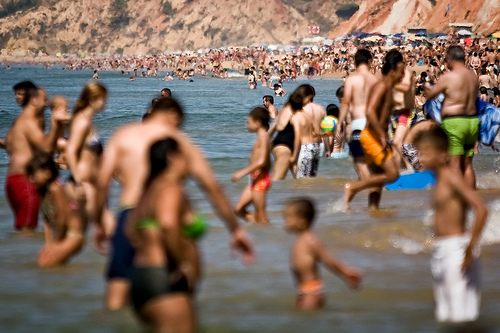
The end of July. School is out, the beach is beckoning, and North America is just emerging from a massive heatwave. OK, so its grey and chilly in much of Northern Europe right now, but for many of us, summer is truly here. And like all self-respecting sunworshippers, we're all too aware that this means it is time for sunscreen. The question is, though, what is the responsible choice among the myriad brands in the market? And what counts for responsible when it comes to sunscreen anyway?

Over at the Ethical Consumer website, help is at hand. The UK-based magazine publishers and all-round ethical shopping wonks produce ethical buying guides for just about everything. Their buyers guide for sunscreen is available free and includes probably more information than anyone could possible want about how the various brands stack up against a wide array of social and environmental issues. Top of the list of things to avoid are potentially harmful chemical ingredients, including various parabens and cinnamates. Not to mention one of the more controversial ingredients around, nanoparticles. These are widely used in sunscreens, but have raised concerns around safety and environmental issues. Of course, the most responsible sunscreen is one that actually works. Natural, non-chemical ingredients are all well and good, but not if they don't guarantee you the protection you need ... or has been the case in the past, do not actually provide the SPF protection they claim on the package. With the EU tightening up regulation a few years ago, some of the "natural" producers have struggled to comply and stay in the market.

That said, unsurprisingly for an organization that has always held multinationals in low regard, the top-ranked brands according to Ethical Consumer are still largely small-scale natural product specialists, such as Yaoh organic hemp sunblock, and Green People sun lotion. Among the more well-known international brands, Clarins, Malibu, and Nivea are among the best scorers, though it has to be said that they all come in at less that 10 out of 20 on Ethical Consumer's scoring system. But this is mainly because the sunscreens are not just being ranked on their ingredients and other product-specific qualities. Ethical Consumer has always taken a more holistic view of a product's ethics, taking into account the producing company's policies and practices on a wide range of issues including employee rights, sustainability reporting, political involvement, and much more besides. In fact "product sustainability" is only one of five categories that a product is ranked on, the others being "environment", "animals", "people" and "politics". In essence, they evaluate the brand, not just the product.

Such a wide ranging assessment may not be for everyone. Some people just want to rate the product, not the whole corporate culture. In the past, you'd just have to stick with the final assessment given by the company doing the rating, but organizations like Ethical Consumer are now providing more sophisticated tools. We love the way they provide a customizable scorecard online so that you can quickly and easily prioritize the ethical issues that matter to you and de-prioritize those that don't just by using the sliding scales. And when you do, the differences between the sunscreen brands turn out to be more driven by company factors rather than simply product-specific factors. That's not to say these company factors aren't important. But clearly, not everyone is going to care as much about all the same issues. So customization is a technique that really works in ethical product ratings.

Where the sunscreen ratings don't quite convince though is on the real basics. People buy sunscreen to get protected from harmful UV rays. An ethical sunscreen has to be one that provides superior protection. But none of the more than 20 categories ranked by Ethical Consumer appear to include an assessment of actual performance. Maybe they just assume that if the products meet the legal standard then they are all of acceptable standard. But as far as we're concerned, ethical performance is not just about the ethical add-ons. It's also about doing the job the product is designed to do - and doing it well.  Marketers refer to this as the "core" and the "augmented" product. If ethical evaluations pay no heed to the core product benefits, then they miss out on half the picture. Its like lying in the sun and using sunscreen on everything except your most sensitive areas. Sure, you're taking precautions - but you're still gonna get burnt exactly where its going to hurt the most. Ethical rankings need to get the essentials covered.

Photo by Pedro Moura Pinheiro. Reproduced under Creative Commons licence  

Thursday, January 22, 2009

Should business boycott Israel?

With all the excitement in Washington over Barack Obama's inauguration, it may be tempting to put to one side for a little while the continuing problems in Gaza that so occupied the public and media attention throughout the last month. But one person clearly not watching Obama's swearing-in ceremony was the UN Secretary-General Ban Ki-moon who spent the day visiting the Gaza strip and Southern Israel. As the world's media widely reported, Ban, standing in front of the smoking rubble of a UN building described the scenes as "heartbreaking", and condemned the destruction as "outrageous, shocking and alarming".

It was an important and symbolic visit by the UN leader who was careful not to take sides in his condemnation of the "excessive force" used by both Israel and Hamas. And it clearly serves to highlight the fragility of the current ceasefire and the need for more determined resolve in finding a lasting solution to the problem. But the burning question, of course, is how can genuine progress to be made in such a complex and volatile political situation?

One suggestion recently put forward by the Canadian activist and author Naomi Klein is that businesses and consumers should take a role in addressing the conflict by actively boycotting Israel. Citing the Palestinian campaign group Boycott, Divestment and Sanctions (BDS). Klein argues that "economic sanctions are the most effective tools in the nonviolent arsenal." And she is not just talking about economic sanctions at the governmental level, but at the level of individual consumers and businesses too.

In fact, her two main examples of anti-Israel boycotting are both business-level actions: first, her own decision to switch publishers in Israel from a commercial publishing house to a small, anti-occupation acivist publisher; and second, a British telecom company, Freedomcall, which had recently sent an e-mail to the Israeli tech firm MobileMax saying "as a result of the Israeli government action in the last few days we will no longer be in a position to consider doing business with yourself or any other Israeli company."

Boycotts against Israel have been mooted, or activated, by academics, journalists and others in recent years - typically to storms of controversy. In the US, companies participating in anti-Israel boycotts can even be fined. However, recent developments in Gaza have clearly prompted a fresh look at some of these tactics by some, although specific instances of boycotts by western companies still appear to be very rare. Our very unscientific search only came up with one other report from the last two weeks - of a London-based Pashmina company which had joined a voluntary boycott on Israel due to "the horrors committed by the Israeli army". However, Ethical Performance also recently reported on Unilever selling its stake in a factory in an illegal Israeli settlement on the West Bank – but also noted that despite the protestations of campaign groups, had done so as part of a broader divestment process from non-core business rather than any "ethical considerations".

Similar protestations of what Klein calls "cold business calculation" are also evident at Freedomcall, where the managing director is quoted by her as saying "We can't afford to lose any of our clients, so it was purely commercially defensive." Such amoral language and the refusal by business to acknowledge that they are also involved in politics is not unusual. But what is unusual is Klein's appararent readiness to accept that business should be taking an active role in state politics, depsite (or even because of) their focus on commercial self-interest. The author of No Logo and The Shock Doctrine is better known for criticising the role of the private sector in the public domain.

It seems unlikely to us that too many companies will feel comfortable joining an anti-Israel boycott, whether for commercial or political reasons. Why? Well, the ethics are simply too contentious for most business leaders to be comfortable making that kind of a call. Apartheid-era South Africa, or the current situation in Burma have a degree of moral consensus that presages corporate decision-making in a way that the problems in Gaza do not. Yes, maybe business leaders should be encouraged to stand up for what they believe in, but this is less likely to happen when they think their customers and other stakeholders might not agree with them. If even Ban Ki-moon is so careful in choosing and balancing his words of censure, corporations will no doubt tread even more carefully. Only concerted efforts by consumer groups and NGOs will be likely to change their views on whether a political boycott makes good sense. For better or for worse, that is the cold hard logic of business that Klein will have to recognize.


Photo copyright Tom Spender